Hear me out, I am a huge sports fan. I grew up in a family where you had to play a sport growing up, no option. So throughout my life, I played a wide variety of different sports; flag football, cross country runnings, snowboarding, swimming, dance, lacrosse, soccer, you name the sport and I probably played at least a season of it in my lifetime. Not to mention watching sports. My house was a hockey house and thus, the Blackhawks were our team. Football was on on Sundays and trust me, we watched it. Baseball games in summer afternoons with my dad were always treasured. But, this isn’t just all going to be sports appreciation. As I got older and learned more about life, I learned more about the effect that sports have on people’s lives, not just my own, and that those effects aren’t always fair. There are a lot of great things about sports and there are some not so great things. So the whole point of this blog is to talk about those two things. How does sport reflect our society? How can it be fair? What are the great things about sports? What are not so great things? So, follow along, from one sports lover to another, and learn something about how sport reflects the views of our society and how it might be an agent for change.
Advertising and Commercialism of Sports
“Without sponsors, there would be no olympic games. Without the olympic games, there would be no dreams. Without dreams, there would be nothing.”- Notice published in an official program for the olympic games
Are sponsors important to sports? At what point do we draw the line of sponsorship and commercialism? Athletes have gone to extremes for their sponsors from wearing their logos on uniforms to having brands tattooed on their bodies. Sponsorship is obviously important in sports due to the need for funding but at what point does the advertising and commercialism become too much.

When you walk into a stadium, you are immediately bombarded by hundreds of ads ranging from insurance to beer to food. These ads can’t just be ignored either because they are often times placed in prominent places that you are forced to look at to follow the game. In fact, advertising has become such a big part of sports that during the Super Bowl, people have commented on the game as the break and the advertisements as the entertainment. Companies pay billions for a 30 second ad during the biggest sporting event of the year.
Why do we care so much about the advertising that is going on? Why do we care about what the brands are or where they are placed? What does it all matter? Something important to consider is the materialism and consumerism that being surrounded by ads creates. As a culture, we care so much about our things and stuff that it is normal to constantly see advertising for it. Do we need to change? That depends on how you feel.
Sports and the Media
The media plays a major role in the consumption of sports. Everyday, new sports blogs (like this one) pop up, podcasts are created (like ours), twitter accounts, instagram accounts, new sports apps, all of the above. There are literally millions of ways to get the latest sport updates for the teams and leagues you follow. Has the media taken over sport? Can one exist without the other? I like to note that without media and tv contracts, it would be extremely difficult to watch the teams we follow. Take college football for example. Not everyone who watches college football is in fact in college, or attending that school. I go to a small private school in Texas but I like to stay up to date with the CSU Rams, CU Buffs, UT Longhorns, LSU Tigers, Ole Miss Rebels and a couple of other teams. If we cut all media out of sports, the odds I’d get to see these teams play are slim. How often in a day does your phone buzz? And how often are those buzzes alerting you to sports updates? I keep my notifications set for news, trades, scores, overtime and other information from the Chicago Blackhawks. Do you play fantasy football or gamble on sports? How do you keep up with your teams? Sports and the media are so intertwined there is almost no way to separate the two.
Coaching and Youth Sports
Something all sports have in common, at the youth, amateur and professional level, are coaches. Everyone has a coach. However, in youth sports, a coach can play a major role in how much you love the sport, your ability to continue on with a sport, and the skills you have to play the sport. When I interviewed Dalton Merka about his sport experience, he consistently mentioned the coaches he has had throughout his sporting career and how they have impacted how he views sports today. Coaching can make or break an athlete and is especially important in youth sports.
Before college, Dalton played tennis at both a youth sports level and on a highschool team. In highschool, he said that they went through four coaches in five years which really impacted how he looked at the sport. It wasn’t until he finally had a good tennis coach that he realized what had been wrong with all the others before that. The school was new and looking to establish a tennis team so they hired anyone they could find. This often meant hiring coaches with little to no experience in the sport or coaching or hiring coaches that were too old to really interact with the players. When he got to a college level, his coaches commented on the fact that he had to overcome such poor coaching to become a better athlete and that his ability to overcome that setback proved him to be a good athlete. But how many children aren’t able to overcome poor coaching to reach higher levels of the sport? How does coaching affect a child’s opinions and desire to play a sport.
Between 15 million- 46 million six to eighteen year olds play sports (Coakley, 2015). Most of those sports have a coach. How does the type of coach you have affect how you play? Dalton talked about how in highschool, he repeatedly encountered coaches who had no experience in the sport or coaches that were too old to really interact with their players. This can really effect how much the athlete enjoys the sport. Dalton said it was really hard for him to keep improving in tennis when he had coaches that didn’t really know what he needed. The Youth Sports National Report Card gave coaching a rating of C overall and noted that most of them time coaches were inadequately trained (Coakley, 2015). How can we expect players to get better if their coaches aren’t trained to make them better athletes? Dalton received a scholarship in tennis and by the time he was playing on a college team, he really noticed the differences between poor and adequate coaching. His coaches pointed out to him that he had to work twice as hard in college to overcome the poor coaching from high school in order to be a college level athlete.
However, a lot of kids don’t stay with a sport when the coaching is bad. Witt and Dangi (2018) reported that coaches with poor communications skills and difficulty interacting with young athletes were a major reason that certain athletes choose to drop the sport all together. They found that children receive undue criticism and anxiety from coaches (Witt et. al, 2018). This anxiety can be a driving factor for why kids might drop out of sports. Children often join sports for the fun of playing, the chance for increased social interaction, and the opportunity to improve their skills. However, if coaches place too much pressure on winning and criticize their players openly, this can lead to an increasing number of players dropping out.
How can we improve this coaching dilemma? A study conducted by Bolter et. al 2018 stated that providing coaches with better training was a key to improving the coach-athlete relationship. In a survey, 87% of youth sport coaches stated that training be required to be a coach at the youth level. Increased training will teach coaches how to better interact with their players and how to tailor certain coaching skills to the specific player based on their needs. Increasing the quality of coaching overall can help reduce the amount of drop out related to coaching issues.
The role of the coach in a sport is not only to improve the athlete but to also get to know them on a personal level. Coaches are in a position to foster youth development through acceptance, teamwork, and cooperation (Vierimaa et. al, 2017). Dalton said that his biggest piece of advice he had for going forward in youth sports was for the coaches. He felt that youth sports shouldn’t be all about winning but instead needed to shift the focus to character development, athletic development and strategy. He reminded me that every player is unique and that not all coaching skills will work for every player. Witt et al. (2018) stated that coaches need to redefine success in terms of keeping the game as fun as possible while also paying attention to giving players the ability to develop lifetime skills. Youth sports are supposed to be fun and the major key to keeping them fun is to make sure that we train good coaches.
Violence in Sports
Violence is a common theme in multiple sports. For example, my favorite sport is hockey and sometimes it almost feels like you were cheated if you leave a hockey game and didn’t see the refs break up at least one fight. Football is another sport that is considered to be fairly violent in which there is often rough tackles and players are often taken off the field with a variety of injuries. But when if violence in sport not justified? Where do we draw the line at what is a normal part of the sport and what is considered unnecessary violence by the athletes?
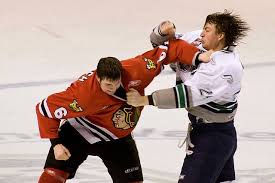
First, it is important to define a few different terms relating to violence in sports. There are four main types of violence that occur in sports. Brutal-Body contact refers to violence that is typical of the game (tackling in football). Borderline violence is not a part of the game but you often see it in a specific sport (fights in hockey). Quasi criminal violence might result in an expulsion from the game and/or a temporary suspension. Criminal violence is what you would expect and typical you end up spending some time in jail for that. So where do we draw the line in sports? Boomers often like to comment on how sports are becoming increasingly violent when the actual data shows that this isn’t true. Sports aren’t becoming increasingly violent, they often just are violent in general and that is something that we as spectators have to remember. The problem with violence in sports is when it leaves the rink or the field and ends up outside the game, people are killed during the game, or people are increasingly violent in a sport for no reason.
 2Guys 1Ball